
National Food System
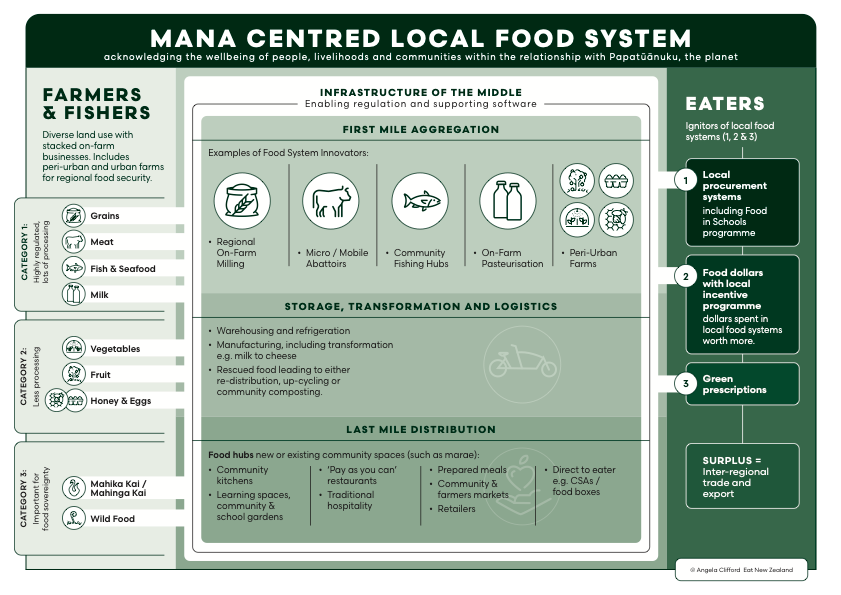
Mana-Centred Local Food System Model and NZ Food System Innovators.
'You can't be it, if you can't see it'. This saying is applied to important equity and inclusivity movements, but it can also be applied to smaller food producers. In Aotearoa New Zealand we have some incredibly innovative, determined and inspirational farmers and fishers.
The fact they even exist in an operating environment that is geared to growth and scale, and is restricted by a retail duopoly, is enough to afford them a standing slow clap.
But some of them don't just exist, they actively imagine a different pathway for themselves, their family and their community.
How do we wrap a local food system around them that encourages this road less taken, and can this system also lead us, as eaters, to better food security, connection and health? What would that look like for different communities throughout Aotearoa, and how would the concept of 'mana-centred' explain how this can be uniquely imagined?
Eat New Zealand, with the support of researcher Heidi McLeod, recently undertook some research through Our Land and Water National Science Challenge which considered the role on-farm mills could play in a local grain economy. Eat NZ Grains is a campaign we've been working on with The Foundation for Arable Research for a few years now.
This research extended to uncovering other farmers and fishers disrupting the value chain by taking back the processing part. So we sought out community fishing solutions, micro abattoirs and on-farm pasteurisation as well. What were their opportunities and challenges? Could we find things that connected these different people and sectors together? Might other food producers identify the right set of circumstances that mean they can stack businesses, diversify their land use and build resilience into their operating systems?
Eat New Zealand has been supporting smaller food producers in Aotearoa for a long time. We recognise they have very little oxygen, collective representation or platforms from which to speak. We've witnessed the demise of many, and have hung our heads when others have explained that they now know very few who exist by working in their business full time. For so many, being a food producer in New Zealand has become a 'side hustle', with outside income elsewhere necessary to supplement the dream.
Given the importance of food security, food sovereignty and food culture, as well as thriving small businesses, we reckon this is not the direction we want to be heading in.
NZ Food System Innovators:
Having issues viewing? Watch the full video here.
Want to see the model in full detail? Download here.
As so the model was born. The birth was facilitated by increasing regional and national calls for food security, agency and resilience.
Importantly, it acknowledges that local food systems need to include more than fruit and vegetable producers. That there are essentially different categories of food based on processing and regulations.
Our wild food resources (including our pest species) and the importance of continued access to areas supplying healthy mahinga kai deserve special consideration. They are places of important culture and sovereignty for Aotearoa.
This model acknowledges that just producing food isn't where things start and finish, but that we also need to design an 'infrastructure of the middle' as well. Almost weekly we see online platforms that seek to connect food producers and eaters, but fail to understand the current dysfunction of what comes between them. As an example, freight and logistics are cost prohibitive for so many small producers trying to reach their customers.
We have stood up food distribution facilities nationally as a result of covid and ongoing need. Can these places be extended to become local food hubs, ensuring long-term funding and pathways to self-reliance?
How do we manifest the food recovery hierarchy as part of this infrastructure of the middle, ensuring genuine food security and agency for all people?
Finally, our Mana-centred local food system will only work if there's demand from eaters. We re-imagine demand that can be enabled at the local government level. This includes procurement strategies or pledges that could include schools, hospitals, caterers, aged care residents, tourism business, hospitality and others. There are examples of this globally, including in Brazil where the country's constitution requires that 30 percent of the ingredients for school meals be sourced from local, family farms. In so doing, the country has helped some four million of the country's small farmers and promoted rural development. Another example is the The Good Food Purchasing Programme in the USA.
There are also central government levers that can be used. These include food dollars that are worth more when spent in local food systems. International examples include Farmers Market Nutrition Programme in the USA.
Eat New Zealand is encouraged to see the increasing connection between food and health, including research into food environments by the Ministry of Health. What are the opportunities to introduce green prescriptions, specifically those which would enable people struggling with food-related health concerns to be prescribed (subsidised or free) fresh, local food by health professionals? New Zealand is cited as a global first adopter in green prescriptions for activity, can we do the same for access to health-giving kai?
We offer this model with the understanding that it could be reimagined by different communities. It's not prescriptive, but rather a starting point to embark towards a different future.
We would love your feedback. Do you think this model could work in Aotearoa? What would you change or add?
Just as 'you can't be what you can't see' is relevant for our small food producers, we offer the mana-centred local food system with the encouragement that 'if you can imagine it, you can achieve it'.
Let's get started. Every step is closer to a food secure, resilient and delicious Aotearoa.
Download the Mana-centred Local Food System Model PDF here.
We can also imagine our urban and peri-urban farms contributing to this model, delivering us a full plate of local food.

Vote for Kai is a collaboration with some of the most impactful organisations in our food system. We’re a collective who believe in an Aotearoa New Zealand where everyone has access to healthy, culturally appropriate kai and Te Tiriti ō Waitangi is honoured in shaping our food system.
Our whenua and moana (land and ocean) provides in abundance, yet too many of our people go hungry. Hunger is not inevitable — it is the result of political decisions.
We think a deliberate and just design of our food system will ensure that there is kai produced in a way that sustains our taiao (environment), including the welfare of our animals, and the livelihood of our producers.
We are calling for courage: to move beyond charity, beyond short-term fixes, and to commit to a food system where there is truly enough for all.
As a citizen-led campagin we are supported by Eat New Zealand, VAWA (Veterinarians for Animal Welfare Aotearoa), Dirt Road Comms, Aotearoa Food Rescue Alliance, Kore Hiakai and Health Coalition Aotearoa.
We’re working on a manifesto for a just, resilient food system for NZ, watch this space and sign up for the newsletter in the meantime.
Ngā mihi,
Angela Clifford, CE Eat New Zealand @eat.newzealand